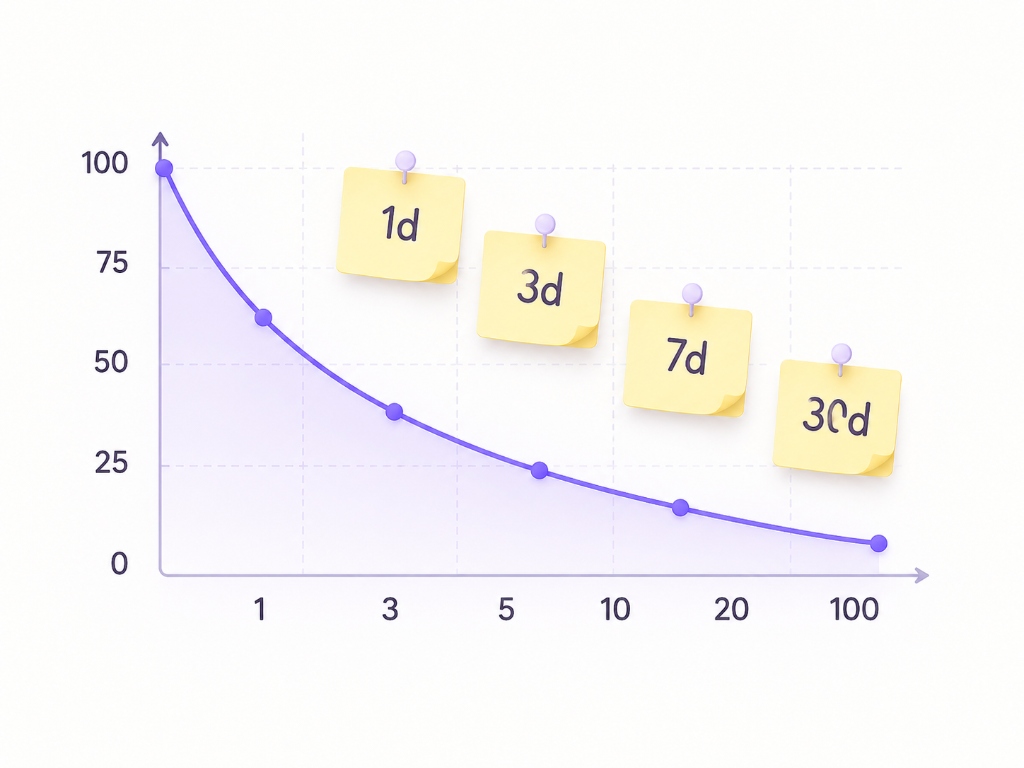
The basic theory behind spaced repetition is incredibly straightforward: instead of reviewing a concept repeatedly in a single session, you spread those reviews out over increasing intervals of time.
If you learn a new term today, you review it tomorrow. If you remember it, you review it three days later, then a week later, then a month later. Each successful recall pushes the memory deeper, slowing down the rate at which you forget it.
The science is settled. Hundreds of studies dating back to Hermann Ebbinghaus in 1885 confirm that spaced practice outperforms massed practice (cramming) for long-term retention.
Yet, while the concept is simple, actually maintaining a spaced repetition routine is notoriously difficult. Most people who start a spaced review plan eventually abandon it. Here is why the system breaks down, and how to build a routine you can actually sustain.
The friction of scheduling
In theory, you can run a spaced repetition system using paper flashcards and index boxes (often called the Leitner system), or with a custom spreadsheet.
In practice, the administrative work required to manage this system quickly becomes a barrier. Deciding which cards to review today, moving cards between boxes, and updating dates consumes time and mental energy. When studying feels like managing a complex database, the administrative friction outweighs the learning benefit.
This is where software is useful. By automating the schedule, you eliminate the cognitive load of deciding what to study. You simply open the tool and focus entirely on the retrieval work.
The sweet spot of memory decay
A common mistake is reviewing material too early. If you review a card while it is still fresh in your mind, the retrieval requires no effort. You confirm that you know it, but you do not strengthen the memory pathway.
To maximize the spacing effect, you want to review the material at the moment you are about to forget it.
This is a delicate balance. If you wait too long, the memory decays completely, and you have to relearn it from scratch. If you review too soon, you waste time. An effective spaced repetition routine relies on an algorithm that adapts to your performance, shortening the interval when you struggle and extending it when you recall the answer easily.
Consistency beats intensity
Spaced repetition is not designed for marathon study sessions. It is designed for daily maintenance.
If you cram for five hours before an exam, you might pass, but the information will disappear shortly after. Spaced repetition works by distributing that same five hours of study into five-minute sessions spread across several weeks.
This shift requires a change in habits. It means trading the high-stress, high-volume sessions for a quiet, daily rhythm. The challenge is not the difficulty of any individual review session; it is the discipline of showing up every day.
The backlog trap
The primary reason people abandon spaced repetition systems is the backlog.
If you miss a few days of study, the cards you were supposed to review do not wait for you. They accumulate. When you return to the app, you are greeted by hundreds of overdue cards. This visual representation of backlog creates anxiety and makes the task feel insurmountable.
To survive the backlog trap, you need a system that manages accumulation gracefully—either by capping daily reviews, prioritizing the most critical cards, or spreading the overdue reviews over several days so you are not overwhelmed.
Keep your cards atomic
The way you write your study material dictates how well you can space it.
If a flashcard contains a paragraph of text with multiple key points, it is impossible to schedule. If you get three points right but forget the fourth, do you mark the card as correct or incorrect? If you mark it correct, you ignore the mistake. If you mark it incorrect, you review the correct parts too frequently.
A sustainable spaced repetition deck is built of atomic cards: one question, one answer. Keep the prompt specific and the response brief. This ensures that reviews are fast, scheduling is accurate, and the daily queue remains manageable.